When planning and deploying PON (passive optical networks), there are specific considerations that must be addressed in advance. This helps prevent complications during installation and throughout the system’s future operation.
Challenge 1. Incompatibility between straight and angled polishing.
Straight UPC polishing is widely used in optical systems – most ports in active equipment are designed for it, and it is used to manufacture connectors for optical patch cords and pigtails. For applications that use the same fiber for both transmission and reception, APC connectors were developed to protect active equipment that is sensitive to back reflections. Since PON technology relies on a single fiber for both transmission and reception for all users, PON equipment manufacturers offer components with green pass-through adapters and ports designed for angle polishing. This applies to splitters, pigtails, at least some of the ports on active equipment at the central node (OLTs), and sometimes to subscriber equipment (ONTs/ONUs).
That said, UPC polishing performed mechanically using modern equipment also delivers acceptable performance for systems of moderate length. The same manufacturer may offer equipment with both APC (green) and UPC (blue) sockets. Pigtail connectors and adapters are colored accordingly. As a result, there is a risk that components with both APC and UPC polishing will end up in the same system.
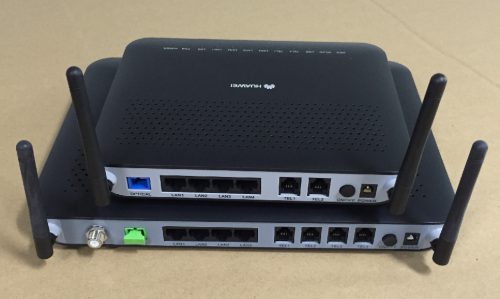
It is important to remember that APC polished connectors are not compatible with UPC polished connectors. Unfortunately, the port form factor for connectors with different polishing types is identical, and it is physically impossible to prevent an APC cable from being plugged into an UPC port or vice versa. It would be wise to select a single type of connector within the same system and use only that type, both in active equipment and in passive components. This will save both users and maintenance personnel a lot of headaches. At the very least, in the “switching zone” where ports connected by optical cables are located, it is strongly recommended to ensure that only one type of port and connector is present – either APC or UPC. Although hybrid cables with connectors of different types at each end are manufactured and available for order, their use significantly increases the risk of incorrect connections – whether due to ignorance, carelessness, or sometimes poor lighting.
Unlike connectors and ports on active equipment, passive APC and UPC pass-through adapters have identical design. They differ only in the color of the plastic. All their physical parameters are the same. A pass-through adapter is merely a mechanical structure for connecting connectors, a guide sleeve that ensures the connectors are aligned. Technically speaking, it would be possible to use blue pass-through adapters to connect green connectors and vice versa, since the main requirement is that the connectors be of the same type. However, from an operational standpoint, this must never be done, as it creates the risk of coupling connectors with different polishing, which will inevitably lead to their damage. The color coding of adapters must provide the user with reliable and unambiguous information about which connector is connected on the internal, invisible side. It is essential to train all staff and users so that no one ever connects connectors to adapters or ports of the wrong color. And it does not matter whether we are talking about ports in active equipment or purely passive pass-through adapters.

Problem 2. Mismatch between the dynamic range of active equipment and the PON attenuation budget for different wavelengths.
As SFP modules improve, PON equipment vendors are increasingly claiming that high optical loss is no longer an issue. Some of them claim that even if the segment is long and contains many splices and connector joints, the transmitters are so powerful and the receivers so sensitive that the network will still function. Nevertheless, regardless of the dynamic range of the transmitting equipment and the sensitivity of the receiving equipment, it is essential to calculate the attenuation budget and then compare it with the loss values obtained from actual measurements.
Depending on the manufacturer and type of optical connector, the maximum allowable loss at a connector joint is not 0.75 dB, but, for example, 0.4 dB or 0.25 dB, and sometimes even less. For a fusion-spliced connection, the allowable loss may be 0.1 dB or even 0.05 dB, rather than 0.3 dB. This affects the calculations – the limits on allowable losses become stricter. It is important to note that PON networks use not only the 1310 nm and 1550 nm wavelengths typical of single-mode systems, but also 1490 nm and 1625 nm (especially when testing on a live network). The per-meter attenuation varies for different wavelengths, and if the budget calculation is performed for 1490 nm but the actual losses are measured at a different wavelength, the figures must be adjusted. To perform the conversion, you will need to refer to the fiber manufacturer’s technical data. For example, Corning specifies the following parameters for its fiber (for comparison, the standard requirements for single-mode fibers of types A–C are provided):
Wavelength | SMF-28e+ LL | G.652.D type A requirements | G.652.D type B requirements | G.652.D type C requirements |
1310 nm | ≤ 0.32 | ≤ 0.34 | ≤ 0.33 | ≤ 0.35 |
1490 nm | ≤ 0.21 | ≤ 0.24 | ― | ― |
1550 nm | ≤ 0.18 | ≤ 0.21 | ≤ 0.19 | ≤ 0.21 |
1625 nm | ≤ 0.20 | ≤ 0.24 | ≤ 0.22 | ≤ 0.23 |
Note the difference in numerical values for different wavelengths – all of this affects the attenuation budget.
But the main feature of PON systems is that they use splitters, which divide the common downstream signal among all users. Dividing the signal results in very high losses. Splitters are passive, and signal gain decreases proportionally simply because the signal is being split. A small amount of light is lost due to the non-ideal design of the splitter, but the main losses depend on the splitting ratio – on a 1:16 splitter, they are approximately four times higher than on a 1:4 splitter, and so on. Exact values are provided by manufacturers in the descriptions for specific splitter models, but on average, splitting the signal into two paths results in an increase in loss of between 3 and 4 dB.
Split ratio | 1х2 | 1х4 | 1х8 | 1х16 | 1х32 | 1х64 |
Average attenuation | 3.8 – 4.0 dB | 7 – 8 dB | 10 – 11 dB | 13 – 14 dB | 16 – 18 dB | 20 – 21 dB |
Splitters contribute significantly to the total line loss. They must be taken into account when calculating the attenuation budget, which determines the selection of active equipment.
Since the downstream path uses a wavelength of 1490 nm and the upstream path uses a wavelength of 1310 nm, the budget calculation must be performed for both cases. The resulting values will differ slightly. Thus, for a 1 km segment (linear attenuation of 0.25 dB/km for 1490 nm and 0.35 dB/km for 1310 nm), using a 1×32 splitter (18 dB loss) and including 6 connector joints (0.25 dB loss each), we get total losses of 19.75 dB at the 1490 nm wavelength and 19.85 dB at the 1310 nm wavelength. If the system uses fusion-spliced connections and pigtails, the losses at the splices must also be included in the calculation. As a result, we get the maximum allowable loss values in the passive transmission medium.
When picking active equipment, it is recommended to include an additional 3 dB in the calculation for reliability – a power margin. The values will then be 22.75 dB and 22.85 dB, respectively, and OLT and ONT devices must be picked with these values in mind. Important: a margin of several dB may only be added when selecting active equipment, not the passive part of the system.
Problem 3. The complexity of selecting testing equipment and using filters.
PON networks are built on single-mode fiber, and from a physical standpoint, one might assume that the same devices used for single-mode structured cabling systems or long-distance trunk lines could be used for testing. However, the specifics of PON technology influence the testing approach, and installers face several nuances that must be taken into account.
Compatibility of testers with APC and UPC polishing
Not all measuring devices have ports compatible with APC polishing. By default, loss measurement devices (OLTS) and reflectometers (OTDR) use cables with straight UPC polishing. It is permissible to use additional optical cables and adapters to switch to a different interface and polish type for measurement. These additional components can be accounted for in the attenuation budget and settings to obtain meaningful measurement results.

However, it is possible to take advantage of the fact that devices where the socket lacks direct contact with the connector end face (for example, where a “collecting lens” is installed on the receiving port) can house connectors with either UPC or APC polishing. Some equipment manufacturers specify this capability in their documentation and user manuals. For example, this is how a simplex SC/APC-SC/UPC reference cable is connected to Fluke Networks DTX-SFM2 optical modules. No additional adapters or connectors are required for this.

In OLTS devices where ports are divided into receive and transmit ports, an increasing number of manufacturers will offer the option to connect APC connectors to the receive port. However, it is essential to take great care not to accidentally connect an APC-polished connector to the transmit port!
In reflectometers, the same port combines the functions of both a source and a measuring device. Currently, the standard solution for reflectometric testing of systems with APC-polished connectors is to use a patch cord (matching cable) with a UPC connector for connection to the instrument and an APC connector for connection to the segment under test.
It is recommended to check compatibility with APC connectors when selecting microscopes and video microscopes for optical connectors. When connecting such a connector, there is no physical contact with the video camera inside the video microscope’s attachment. However, the angle at which the illumination is directed and the angle at which the end-face surface is visible may be significant.
Alignment of OLTS and OTDR specifications with PON network characteristics
Equipment for testing PON networks must be designed to handle high loss levels and, consequently, have a large power margin. While in a standard structured cabling system losses in single-mode segments of a typical configuration over a 1 km length amount to 2–3 dB, in PON networks over the same length, the figure runs into the tens of dB. Passive optical networks can even be much longer, making the dynamic range of the tester or reflectometer critical.
Since PON technology uses wavelengths of 1310 and 1490 nm (and 1550 nm if video is being transmitted), optical loss testers must be capable of operating at all these wavelengths. Re-calculating from one wavelength to another is possible, but direct measurements are a more reliable way to determine system characteristics, which is especially important during system acceptance testing.
If a signal is lost during the operation of PON networks, the problematic area can be roughly identified by the number of users who have lost access. If the outage is widespread, the problem should be sought in the general network section. If it is isolated, look for it in the segment between the splitter and the user. However, a reflectometer is still required to precisely determine the location of the failure in the transmission medium. In a passive network, the signal from the reflectometer – whether direct or reflected – will reach all users one way or another. Therefore, it is advisable to use a wavelength outside the range used for standard signal transmission by active equipment, rather than the active wavelength, for measurements. For PON diagnostics, it is best to choose OTDR models capable of capturing a reflectogram at a wavelength of 1625 nm. The system must be equipped with the necessary filters and have ports specifically designed for connecting measuring equipment.
Use of wavelength filters
To ensure that the signal from an OLTS tester or OTDR does not affect active segments and does not disrupt the operations of users unaffected by the outage during fault detection, simply selecting a wavelength of 1625 nm is not sufficient. Filters must be planned for during the network construction phase. This is the only way to conduct testing without negatively impacting the ongoing operation of OLT and subscriber ONTs.
Problem 4. System scalability challenges.
When planning a PON system, the splitter’s characteristics are factored into the attenuation budget. If the central and subscriber active equipment has already been selected and is in use, and all ports on the splitters are occupied, it becomes difficult to expand the system later. This would require replacing the splitter (or cascading them in series), which inevitably leads to a significant increase in losses. If the existing active equipment cannot ensure stable operation under such conditions, it will have to be replaced, which entails significant costs. In fact, almost the entire system, with the exception of the common single-mode fiber and existing user single-mode segments, will be subject to change.
It might be advisable to build in a large margin of equipment capacity at the initial stage so that the system can be expanded several times over later on. However, this entails excessively high additional costs. These costs are difficult to recoup, so in practice, PON systems are not designed with the possibility of radical expansion in mind. Splitters are configured from the outset for the maximum possible number of users. PON systems can be considered scalable only to a limited extent. It is important to understand that the previously mentioned addition of 3 dB in the calculation is required for reliable transmission in the current configuration, not as a guarantee of future system expansion.
Problem 5. Maintaining bend radius, connection cleanliness, and fiber integrity.
In optical systems of any type, it is always important to comply with requirements for fiber bend radius and the quality (cleanliness) of optical connections. This directly affects the system’s performance and operational reliability. Both during deployment and during the operation of PON networks, fiber optic cleaning tools, microscopes, and video microscopes must be used. Unused connectors in cables and splitters must be covered with protective caps. Fibers and cables must be carefully routed through conduits, racks, and trays – without sharp bends, and protected from deformation and adverse external factors.
In PON networks, all these measures are implemented both for the shared single-mode fiber and for each user segment. Support tools that facilitate the work include equipment for dry and wet cleaning of connectors, optical and video microscopes, as well as visible light sources.
Conclusions
Despite their apparent simplicity, passive networks require a high level of expertise during the design phase as well as during installation and operation. Any of the issues listed in this article can lead to significant additional costs and negate the expected savings from using PON technology, not to mention the loss of time.
As early as the preliminary calculation stage, the designer must keep in mind the attenuation budget, the number of splitters, the specifications of active equipment, the types of polishing in ports and connectors, and even the models and configurations of testers that will subsequently be used by installation teams to verify the systems. Installers must have the necessary technical equipment (tools, instruments, consumables, etc.) and possess sufficient experience and knowledge to properly perform installation and measurements. Operations specialists must also have professional-level training, as even the most perfectly designed and installed system can be “ruined” by incompetent maintenance and poorly organized support.
Only if all factors at every stage are taken into account, carefully considered, and coordinated with one another will the final system be reliable and cost-effective.
Important reading: PON network testing with OLTS and OTDR

Written by Vasiliy Grodetskiy | CTO of Splice.me
With over 20 years of experience in fiber network engineering, Vasiliy has been directly involved in the evolution and deployment of fiber infrastructure worldwide. Vasiliy brings deep expertise in industry standards, regulatory environments, and the practical trade-offs between different approaches to fiber network roll-out.